
What is motion design, and when should you use it in your communication?
By Ludwig · 25 March 2026 · updated on 20 October 2026
In short
Motion design brings shapes, text and illustrations to life to get a message across faster and more clearly than text alone. It excels whenever you need to show what a camera cannot film: a process, an abstract offer, an identity that needs to come alive. But it replaces neither a clear message nor a real face telling their story.
Does your message already fit in one sentence?
Start with the message, the animation comes later
Is what you want to show beyond the reach of a camera?
A filmed video may serve your purpose better
Motion design is the right tool
Neither a cartoon nor just a video
The term appears in more and more briefs, often without anyone knowing what it covers. The result: a film ordered because “it looks modern”, and nobody can say what it achieved.
Design that moves, with intent
Motion design, literally “design in motion”, animates shapes, text and illustrations. A video films a reality that already exists; motion design builds one, in the service of a single message. Every transition has a reason: to guide the eye, highlight a piece of information, spark understanding. Nothing is there for show.
“A camera shows what exists. Motion design shows what can be understood.”
Making visible what cannot be filmed
An internal process, a financial mechanism, a technology hidden inside a machine… Where the camera sees nothing, animation shows everything, in the exact order your audience needs to take it in.
Four situations where it really makes a difference
Explaining an offer that is hard to put into words
A fiduciary firm launching an online service, a B2B industrial company whose value lies in an invisible component, a physiotherapy practice and its rehabilitation protocol… Text quickly gets dense. A one-minute film breaks the offer into visual steps, syncs image and voice, and spares your prospect the effort of piecing it all together alone.
Bringing an identity to life
An identity is more than a logo. It is also the way it moves: a logo that animates, the opening of a presentation, a welcome screen on a trade fair stand. Movement turns static brand guidelines into a recognisable presence.
Getting your teams on board
Internally, an animated sequence presents new values better than a memo, and a training module makes a complex procedure digestible. Your employees also judge the company by the way it speaks to them.
Marking a key moment
A gala, a general meeting, a launch: a few minutes of animation give the moment the weight it deserves.
The film for the Foundation's 130th anniversary: +10% in donations from the very first gala where it was screened. Read the case study →
When it is better to hold back
Your message is not yet clear
A vague message stays vague when animated. It just gets more expensive. If your team cannot say in one sentence what the film should get across, the animation will freeze that hesitation, frame by frame.
“We would like a modern two-minute animated video to present our company and all our services.”
Send the briefThe studio can produce anything… except a film that reaches a goal nobody has set.
“After 60 seconds, an industrial buyer must know that we reduce their line stoppages, and ask for a demo.”
Send the briefOne audience, one idea, one action: the film finally has something specific to set in motion.
Your brief runs to three pages but not one sentence?
That is a sign the message deserves a detour. We will clarify it with you, in 20 minutes.
Authenticity matters more than clarity
A customer sharing their experience, a CEO speaking to camera, a tour of a joinery workshop: these formats create a closeness animation cannot imitate. Motion design clarifies, filmed video humanises. The two complement each other.
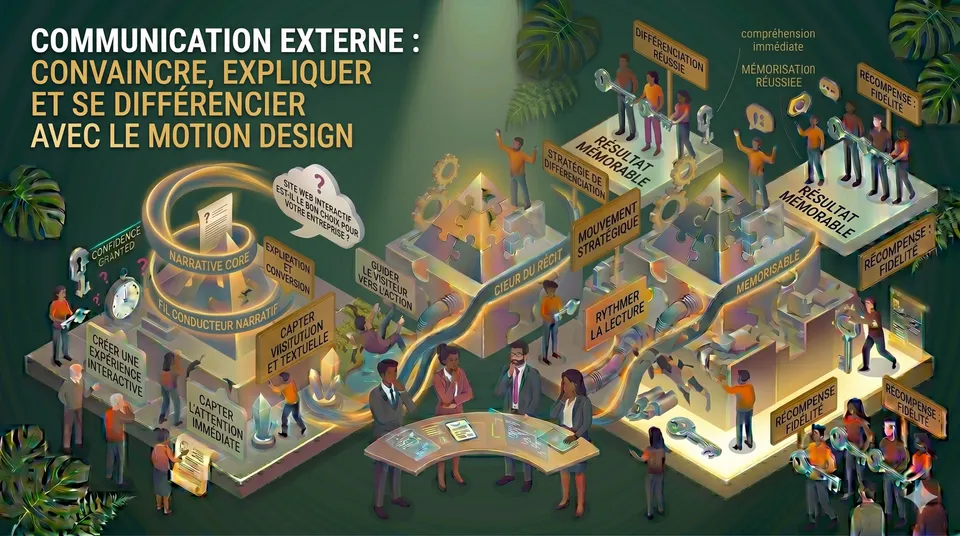
Why animation is easier to understand
What happens in your audience's mind when a complex message is set in motion.
Before any brief, one question
Before contacting a studio, ask yourself which precise idea your audience should remember after the film. Just one. Not the list of your services: a promise, a transformation.
One sentence, one audience, one action
If you can say who the film is for, what it should get across and what viewers will do next, you have a solid brief. If not, start with the message: the film that follows will be all the sharper for it.
Is motion design the right tool for you?
Think about the film you have in mind and tick what is true:
Your priority: the message. Write that sentence before talking about images or style.
Your priority: check the format. If a camera can show everything, a filmed video may be the better fit.
Your priority: the context. A film for a stand is not built like a film for your website.
Your priority: what comes next. Decide on the action you expect, then build the film to lead there.
Your project has everything it needs to become a good film. Now it just needs its rhythm.
Your priority: the message. Write that sentence before talking about images or style.
A message ready to move?
Short films that explain, reassure and stay with people. The message first, the animation second.
Motion design is neither a fad nor a gimmick. It is a precise tool… and it gives its best when you know what it is for.