
Why your audience does not remember your message, and how to fix it
By Ludwig · 24 March 2026 · updated on 20 October 2026
In short
If your audience does not remember your message, it is almost never because your subject lacks interest. It is because the message says too much, talks about you rather than them, or changes with every medium. One central idea, a story your audience recognises themselves in, and consistent repetition are enough to make it stick.
Can you name the one idea your audience must remember?
Your message lacks a central idea
Does that idea speak to what your audience is going through?
Your message is about you, so it slides off
Now repeat it, everywhere and for a long time
Your audience's brain filters
You polished your presentation, published content, shot a video. And yet your prospects still do not really know what you do, or why they should choose you. Budget is not the issue. Nor is format.
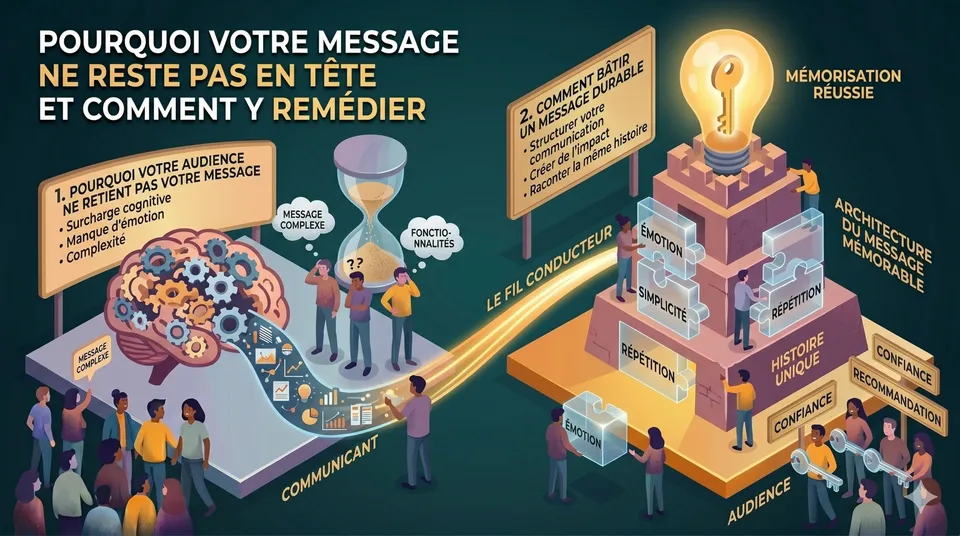
Memory does not work like a hard drive. It filters, selects, simplifies… in a few seconds, without asking your opinion. A message that tries to say everything does not get through that filter.
Too much information kills information
Every idea you add weakens the ones already there. It has nothing to do with your audience's intelligence. Nobody retains ten new things at once. A memorable message is one that dared to choose: one idea, one promise. The rest exists, but in support, never in competition.
A message that talks about you
Your values, your processes, your certifications… Each of these forces your audience to translate: “what does this have to do with me?” Most people do not make that effort. They move on. What speaks directly to their situation, on the other hand, needs no translation.
“Your audience does not forget what you say. It forgets what was not about them.”
What really sticks
Recognition, the simplest emotion
We remember what made us feel something. That does not mean aiming for tears. In business communication, the most effective emotion is often the quietest: recognising yourself. When your reader thinks “that is exactly what I am going through”, it sticks. Because you have just talked about them.
A story rather than a list
A list of facts fades. A story stays. Your situation, what is holding you back, what can change: our brain follows that path effortlessly and keeps it for a long time. Web page, sales presentation or simple email, you can always choose to tell rather than list.
Physiotherapy, manual therapy, lymphatic drainage, strengthening, shockwave therapy, taping.
Our servicesSix techniques in one line. The next day, the reader remembers none of them.
Is your back waking you up at night? We find out where the pain comes from, then teach you how to keep it at bay.
Book an appointmentA real situation, a way out: that is what the reader will tell friends and family.
Three steps to be remembered
Reduce to amplify
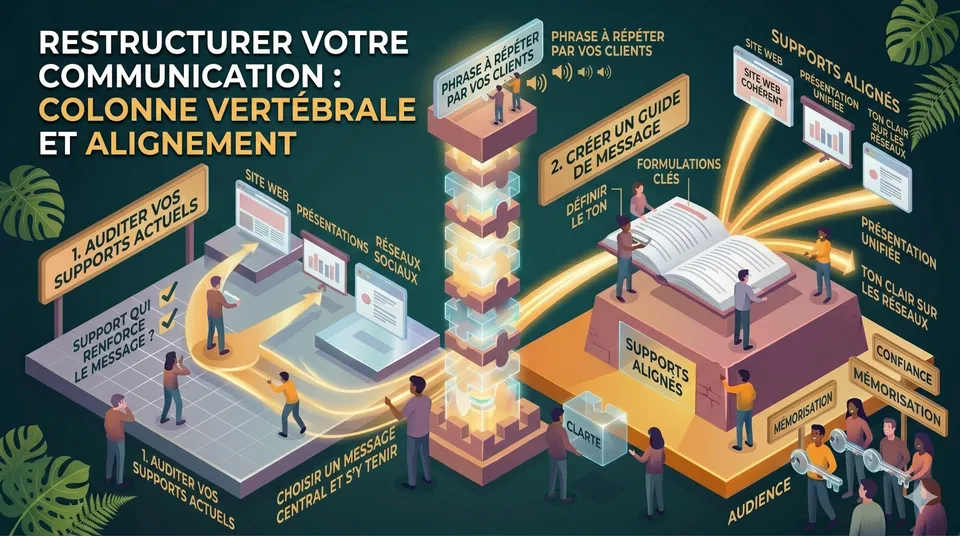
Find the sentence you would want remembered if the other person could keep only one. Short, concrete, in their own words. It is the sentence your clients will use to recommend you. Anything that does not strengthen it weakens it.
Can't settle on a single idea?
That is true of almost every company that knows its trade well. We find it with you, in 20 minutes.
Benefits rather than features
“A five-step method.” “Fifteen years of experience.” These sentences describe what you have, not what your client gains. Rephrase each feature as a concrete change for them, and attention follows.
The same idea, again and again
What takes root is what your audience comes across regularly, in different forms, with the same thread. The message stays stable. Only its presentation changes.
And in the Swiss market?
Precision, consistency, local proof: what makes a message memorable for your clients in Switzerland.
The mistake that wipes everything out: changing your message
Your team tires of its message long before your clients do. After a few months, the temptation to rewrite everything, adopt a new slogan, a new hook, is strong. Your audience, meanwhile, was only just starting to remember the old version. Every change resets the counter to zero.
Refresh your examples, visuals and formats, yes. Your central idea, no. Its stability is what eventually makes it familiar.
Does your message stand a chance of being remembered?
Think of your last presentation or your home page, and tick what is true:
Your priority: the central idea. Write it down, then remove everything that competes with it.
Your priority: recognition. Open with your client's situation, not with your company.
Your priority: benefits. Translate each feature into a concrete change for them.
Your priority: consistency. Settle on your central idea and bring it to life everywhere, for a long time.
Your message has everything it needs to last. Perhaps all it lacks is a form worthy of it, so it truly sticks.
Your priority: the central idea. Write it down, then remove everything that competes with it.
A message that stays in people's minds can be built.
We tighten your message around one central idea and a story your clients recognise themselves in.
Your audience does not lack memory. It lacks a reason to remember… and that is yours to give.