
Strategic storytelling vs traditional communication: what's the difference?
By Ludwig · 24 March 2026 · updated on 20 October 2026
In short
Traditional communication describes your company, its services and its values. Strategic storytelling organises the same content around what your customer is going through, which makes it clearer and more convincing. The difference is not about style but about structure. And a single question tells you which one you need.
Do prospects already know you when they first come across you?
Your materials need to persuade, not just inform
Have they already decided to work with you when they arrive?
They are missing a reason to choose you
Informative communication may be enough
Traditional communication informs, and that is useful
Many companies use the two terms interchangeably, or see storytelling as a more creative version of communication. That misunderstanding is expensive: polished materials, produced at great cost, that trigger nothing.
What it does well
Traditional communication answers the basic questions: who you are, what you offer, how long you have been around, how to reach you. This information is necessary. It builds credibility. For a company whose reputation arrives before the visitor does, it may even be enough: the prospect is already convinced.
Where it stops
It presents, but it does not guide. It describes what the company does without telling visitors why it matters to them. Someone who discovers you without knowing you understands what you do, but not why they should choose you. So they keep looking.
Strategic storytelling: a method, not a style
The customer first
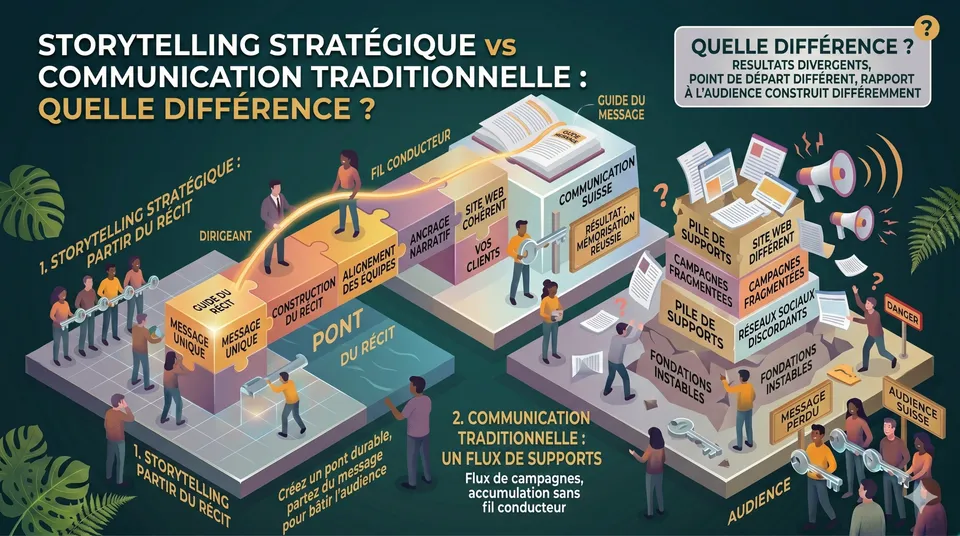
Strategic storytelling is not a makeover for traditional communication. It starts somewhere else. It organises your message around what your customer is going through, what they are looking for and what is holding them back. The website no longer lists services, it guides a journey. The presentation no longer describes the company, it solves a problem. The video no longer shows the offices, it shows a transformation.
What your prospect no longer has to do
With materials built this way, your prospect no longer has to translate your offer into their own situation. The materials do that work for them. That saved effort is what turns a passing visitor into a prospect who picks up the phone.
“Your customers don't choose the company that describes itself best. They choose the one that understands them best.”
Two differences that change everything
The starting point
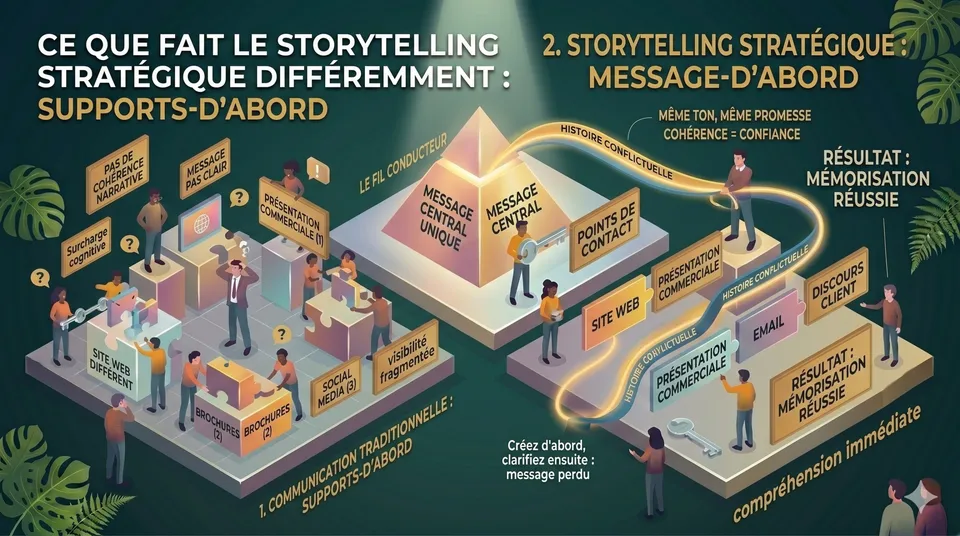
One asks: what do we want to say about ourselves? The other asks: what problem is our customer trying to solve, and how can our answer become the thread running through our communication? With exactly the same basic information, these two questions produce texts that have nothing in common.
Founded in 1987, our architecture practice brings together a passionate team serving public and private projects.
Discover the practiceReaders know who you are. They don't yet know whether you understand their project.
Your house is getting too small, but you love your neighbourhood? We extend it so it grows with your family.
Tell us about my projectReaders recognise themselves, glimpse what comes next, and know how to take the first step.
Inform or persuade
Traditional communication assumes that a well-informed prospect will make the decision alone. Strategic storytelling walks them to it: it removes doubts, builds trust and shows them what changes for them. Informing and persuading do not take the same path.
Finding it hard to reorder your own message?
From the inside, everything seems important and nothing wants to come second. We find the right starting point with you, in 20 minutes.
Back to basics
What storytelling really is, and why your company needs it far more than a big brand does.
Not rivals, but allies
Clarity, either way
Pitting the two approaches against each other would be a mistake. They share one requirement: a clear message. A confusing brochure informs no one, a muddled story persuades no one. Before you tell a story, you need to know exactly what to say.
Structure and materials
Adopting strategic storytelling does not make your information disappear. It reorders it. Your services are still there, but after the benefits. So are your values, but they come through in the way you speak to customers rather than in a list on the “About” page. Storytelling provides the structure, traditional communication supplies the materials. One without the other does not stand up.
One question to decide
Does your prospect already know you when they open your website or your presentation? If so, they are looking for information, and clear communication may be enough. If not, your materials have to do the persuading that your reputation cannot yet do for you. For most SMEs in French-speaking Switzerland looking for new customers, it is the second case.
Do your materials inform, or do they persuade?
Open your website or your latest presentation, and tick what is true:
Your priority: the starting point. Rewrite your opening from what your customer is going through.
Your priority: the order. Put the benefits before the catalogue.
Your priority: persuasion. Ask a stranger what would make them call you, and fill the gap.
Your priority: embody them. Replace each stated value with a concrete example of what it changes for the customer.
Your materials already do the persuading. Now check that they all tell the same story.
Your priority: the starting point. Rewrite your opening from what your customer is going through.
Ready to move from describing to persuading?
We reorganise your message around your customers, without losing anything that makes you credible.
Informing means saying who you are. Persuading means showing your customer who they can become thanks to you.