
What is storytelling and why does your business need it?
By Ludwig · 24 March 2026 · updated on 20 October 2026
In short
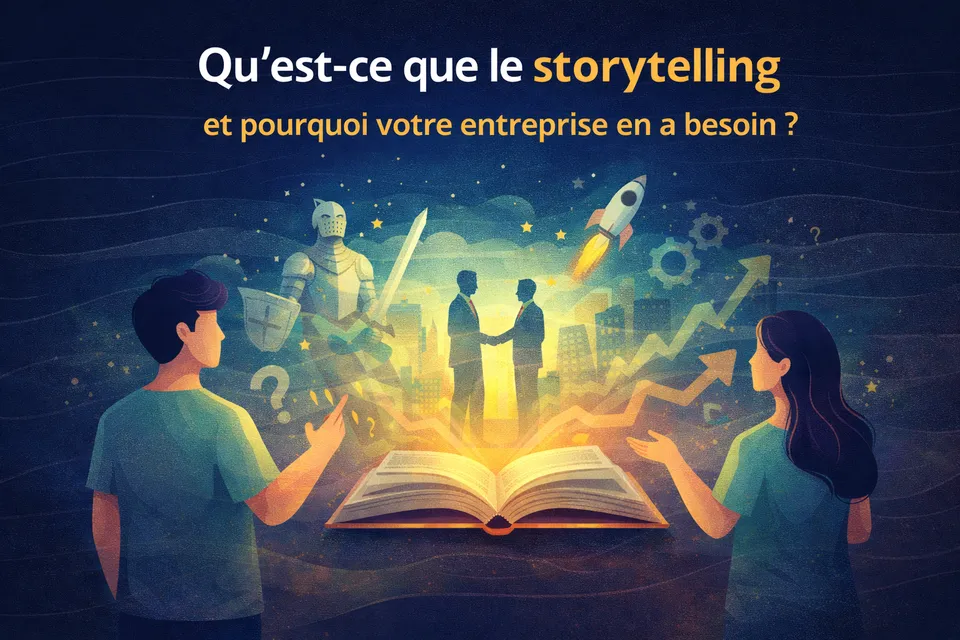
Strategic storytelling has nothing to do with fairy tales. It organises your message around what your client is going through, rather than around what you do. The result: a website, presentation or video in which your prospect recognises themselves, and which makes them want to call you.
Does your client recognise themselves in your first sentence?
Your message talks about you, not them
Do they know what they gain by contacting you?
The promise is missing
Your message already tells a story
Storytelling isn't about telling stories
The word is everywhere, to the point of describing almost any communication with a bit of polish. For us, strategic storytelling is a precise method. It isn't about embellishing your background or slipping in an anecdote about how the company started. It's about organising information so the person in front of you understands, very quickly, why what you do matters to them.
“Your client isn't buying your story. They're buying the next chapter of their own.”
Informing or convincing: a question of order, not style
A product sheet informs. A story convinces. The difference isn't in the words you choose, but in the order they arrive: a situation the reader recognises, an obstacle that speaks to them, then a way out they can picture. Our brain follows that path naturally. A list of services, much less so.
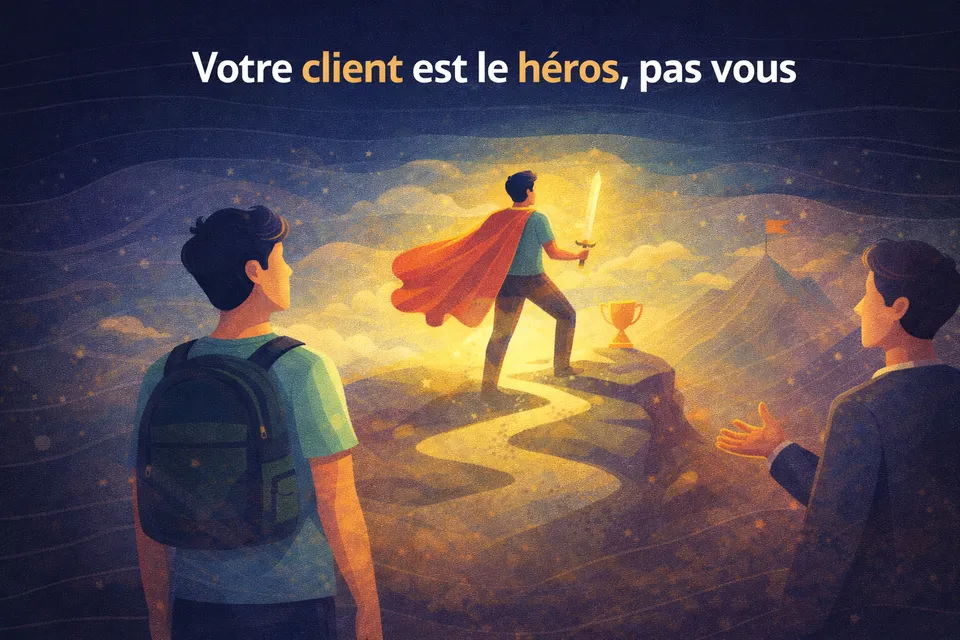
The hero of your story is your client
This reversal changes everything. Most materials start with the company: its founding date, its values, its expertise. The prospect, meanwhile, arrives with just one question in mind: do these people understand my problem?
Putting your client at the centre means naming what they're going through before talking about what you do. The day that overflows, the figures they can't make sense of, the quote they can't defend internally. When they recognise themselves in your first lines, they keep reading. Otherwise, they go looking for someone who understands them.
Founded in 1998, our fiduciary firm offers a full range of accounting and tax services.
Discover our servicesThe reader learns how old you are. They still don't know whether you can help them.
Is your accounting eating into your evenings? We make it clear, and give you your evenings back.
Let's talk about your figuresThe reader recognises themselves from the first line, and knows what to do next.
Finding it hard to describe your business from your clients' point of view?
It's often the hardest thing to see from the inside. Let's find your first sentence together, in 20 minutes.
What it changes for your business in practice
Your visitors decide faster
Your existing clients understand you, because they already know you. The real test is the person discovering your website for the first time, with no context. A message built like a story saves them the search: they understand what order to read you in, why you're relevant, and what to do next.
Your expertise becomes memorable
Two companies can offer the same services, at the same prices, with the same guarantees. The one your prospect remembers is the one that made their situation feel familiar. Not its certifications. Not its twenty years of experience. The feeling of being in the right place.
And compared with conventional communication?
What strategic storytelling changes, point by point, compared with traditional communication.
Two misconceptions that hold businesses back
“It's for big brands”
Big brands can make up for a vague message through repetition. A small business doesn't have that luxury: it has a few seconds, often just one chance. That's exactly why it has the most to gain from a clear message.
“Our business isn't interesting enough”
Every business, however technical, rests on the same reality: people with a problem, and a company that knows how to help them. It isn't your trade that has to be fascinating. It's the way you connect it to what your clients are going through.

A repositioned message that speaks first to the challenges of its industrial clients. Read the case study →
Where to start?
Before touching the design or the tools, reread your materials with a single question in mind: does my client recognise themselves in what I'm saying? Not you. Them. If they find neither their situation nor their doubts in your copy, that's where it all begins.
Does your message already tell a story?
Open your homepage and tick what's true today:
Your priority: flip the point of view. Rewrite your opening line starting from what your client is going through.
Your priority: clarity. Test your opening line on someone who doesn't know you, and note what they take away.
Your priority: consistency. Set a common thread before producing any new material.
Your priority: the next chapter. Offer a concrete, reassuring step rather than a bare “Contact us”.
Your message holds up. Now check that it resonates with the right people: that's often where everything is decided.
Your priority: flip the point of view. Rewrite your opening line starting from what your client is going through.
Want an outside view of your message?
We structure your message so it becomes the engine of all your communication.
Storytelling isn't a trend. It's a way of making a message clear and memorable. And when the message is right, everything else follows.