
How to structure your company's message in 3 steps
By Ludwig · 24 March 2026 · updated on 20 October 2026
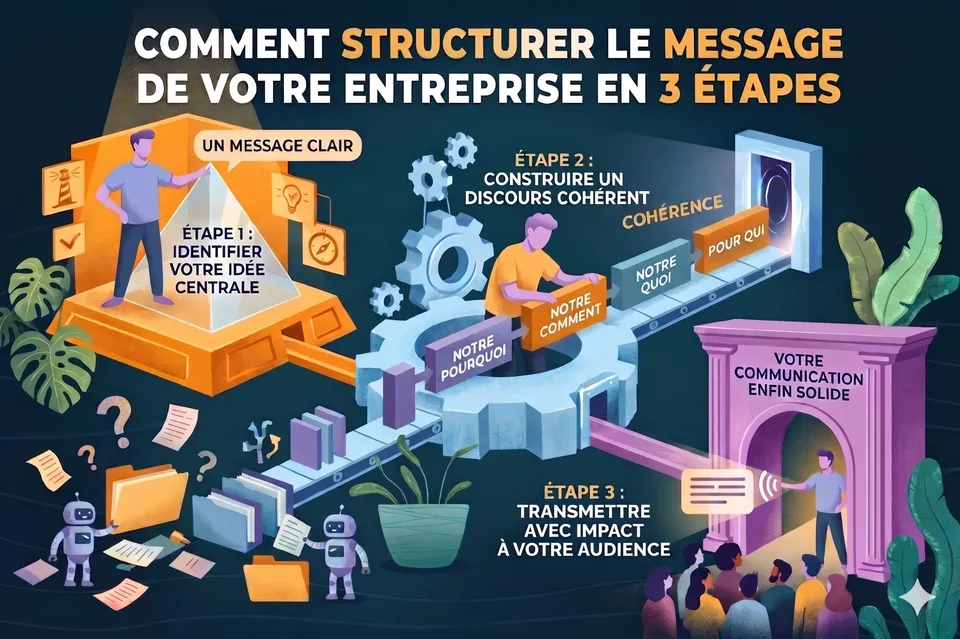
In short
Most companies don't have a content problem, they have an order problem. Structuring your message comes down to three steps: name your customer's problem in their words, express your positioning in a single sentence, then run that common thread through everything you produce. Once that work is done, every text, every presentation and every film is quicker to write… and more convincing.
Does your message start with your customer's problem?
Go back to step 1, the starting point
Does it fit in one sentence a stranger understands in ten seconds?
Your priority: the positioning sentence
Now run the common thread through all your channels
You don't have too little to say, but too much
Your services, your method, your story… There is never a shortage of material. What is missing is a way to decide what to say first, in what order and in which words.
Without that decision, your texts talk about you, your materials don't echo one another… and nobody really remembers your message.
Step 1: Start from what your customer is going through
What they feel, not what you do
Your customers are not looking for a supplier. They are looking for a way out. Their website brings in no enquiries, or their expertise stays invisible.
Naming that reality is the first thing that creates a connection. Your reader thinks: “they understand exactly what I'm going through”. And that thought shapes the rest of your relationship.
Their words, not yours
If your customer described their problem to a friend, what would they say? Not in your industry jargon. In their own words. That wording is what triggers recognition… and recognition opens the door to trust.
“A clear message never starts with what you do. It starts with what your customer can no longer do.”
Step 2: Say it all in a single sentence
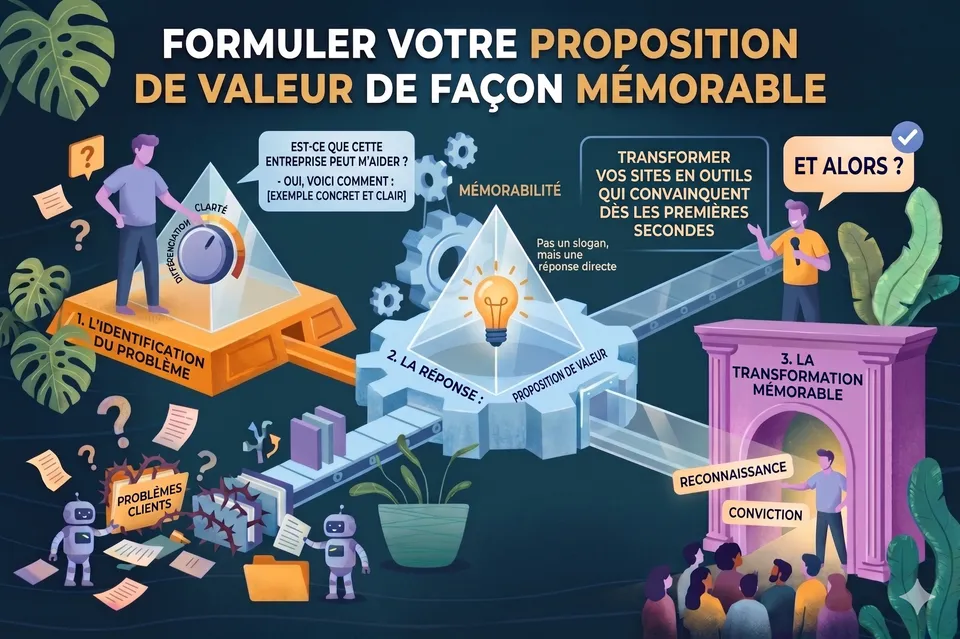
Problem named? Now state what you do for your customer. Not a list, not a paragraph. One sentence. The exercise forces you to let go of nuances you are attached to… and that constraint is exactly what produces strong messages.
Who, what problem, what change
A good positioning sentence answers three questions in one breath: who you are speaking to, what problem you solve, and what changes for your customer thanks to you. It does not describe your services. It describes an outcome.
Family joinery for three generations: fitted interiors, staircases, windows and doors in solid wood.
See our workThe reader finds a catalogue. They don't yet know whether these craftspeople understand their project.
Off-the-shelf furniture doesn't fit your space? We design and build pieces made to fit your walls.
Have my room measuredThe reader recognises their problem, sees the way out and knows what the next step is.
The ten-second test
Show your sentence for ten seconds to someone who doesn't know your business. Then ask them who you are speaking to, what problem you solve and what the customer gains. If they answer without hesitating, your sentence works. If not, back to the workshop.
Your sentence won't fit on one line?
That's normal: your work is rich, and you see it from the inside. We will find it with you, in 20 minutes.
Step 3: Run the same thread everywhere
The same message, adapted to every format
Your homepage, your offers, your emails, your presentations and your videos must tell the same story. The tone can vary. The positioning stays put. A prospect moving from your website to your presentation should be continuing the same conversation.
Repetition builds trust
Every consistent touchpoint reinforces the same impression, until the day the need arises. Being memorable is not about creativity. It is about consistency.
What if your audience remembers nothing?
Even a well-structured message can slip away. Here is why it fails to stick, and how to make it last.
Two habits that undo all the work
Speaking to everyone
Widening your target feels safe. In reality, a message aimed at everyone reaches no one in particular, because nobody recognises themselves in it. Choosing your main customer closes no doors. It finally opens the right one.
Confusing a message with a catalogue
A list of services informs those who already know what they are looking for. Everyone else finds nothing there. A message starts from the problem, a list starts from the answer. And your prospect is the one living with the problem.

The message first, built around its customers' challenges, then a restructured website to carry it. Read the case study →
Is your message structured?
Reread your homepage and your latest presentation, and tick what is true:
Your priority: step 1. Write down the exact phrases your customers use when they call you.
Your priority: the single sentence. Write it, test it and rewrite it until it passes the test.
Your priority: the common thread. Align your materials with your sentence before producing anything new.
Your priority: choose. Describe the customer you want more of, and write for them.
Your message has its structure. Now it needs the form that brings it to life, one channel at a time.
Your priority: step 1. Write down the exact phrases your customers use when they call you.
Ready to settle your message once and for all?
We structure your message so it can then guide your website, your presentations and your films.
The message is the foundation, design is the form. A beautiful form on a weak foundation stays beautiful… and convinces no one.